Your jaw massage works. So why is it tight again by morning?
The release under your thumbs is real. It does not last because of what happens to the muscle after you fall asleep. Here is the loop you are in, the one thing rubbing cannot give the muscle, and what can.
You found the spot, pressed, and felt it let go
Maybe it was a video. Someone showed you where the muscle is, in front of the ear or on the inside of the cheek, and told you to press and hold.
And it worked.
“I was in huge pain, and on the very first massage exercise the pain was relieved almost instantly!”
“Releasing that muscle inside the mouth was the golden ticket. The relief was INSTANT.”
After doctors and dentists who had nothing for you, your own hands did something. That feeling is real, and you were right to trust it.
What it has takenThen it came back, and the routine became a job
“it definitely relief but it comes back again after 2 days”
For some people it is two days. For some it is the next morning.
“I have been doimg this video every day for the past 5 days i have felt the tightness just to say in my jaw however it hasn't lasted longer then a minute”
So you do it again. Before bed, at your desk, in the car. It has become a part of every day.
“I have to say, it's been six years since I first watched this video, and I still come back to it whenever my jaw is tense”
Six years. The release works every time, and the jaw is tense again every time. Both things are true, and there is a reason.
Why it does not holdYour thumbs reach the muscle. The night undoes them.
Here is what your hands do. Pressing and rubbing pushes blood through the muscle and stretches fibres that were stuck short. For a while the muscle has what it needs, and it lets go.
Then you fall asleep, and the clenching starts. You do not feel it and you cannot stop it. By morning the muscle is back where it was.
So the massage is not failing. It is doing a small part of the job, a few minutes at a time, against something that runs for hours.
The real causeYour jaw muscle is not too tense. It is starved, and a starved muscle cannot let go.
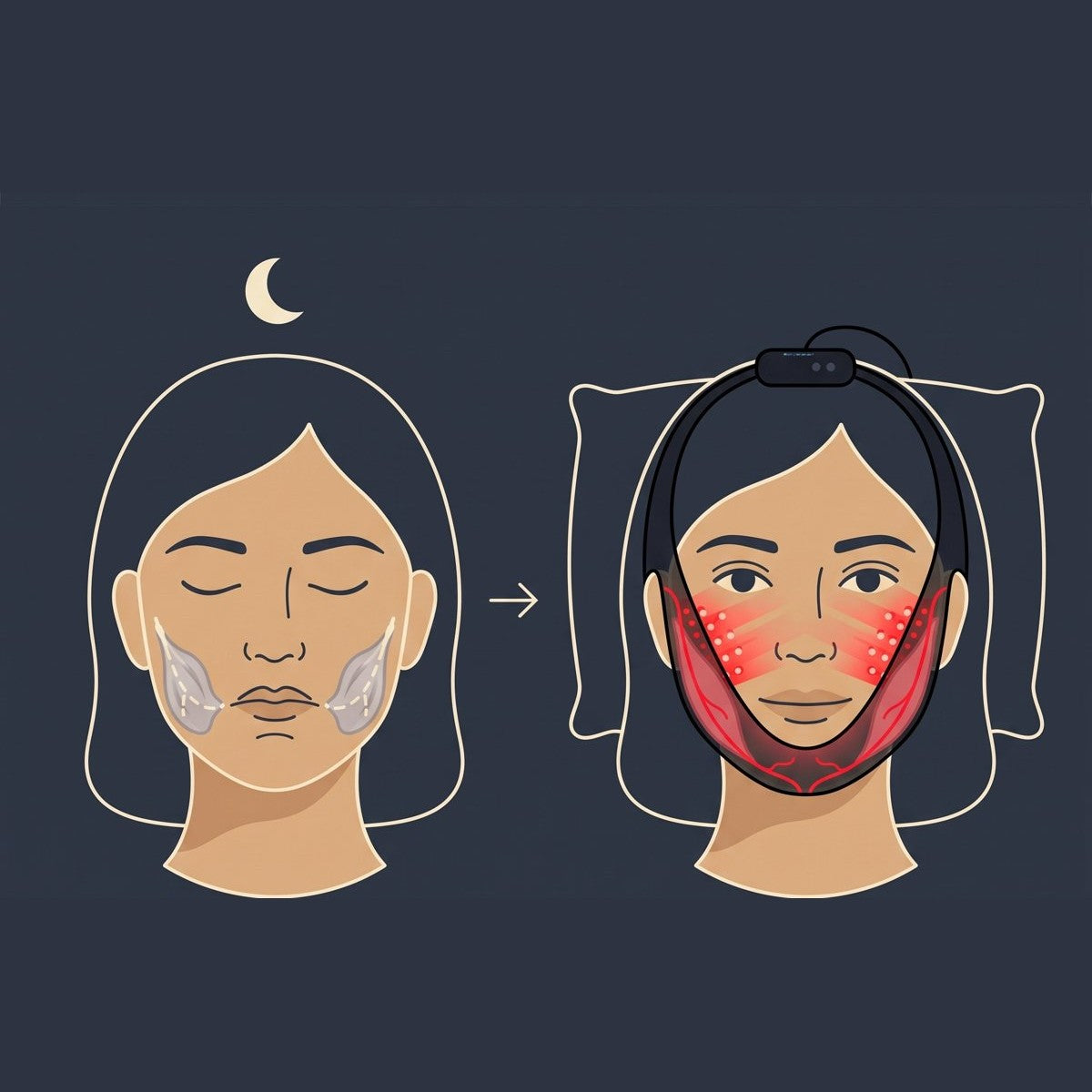
Start by finding it. Put two fingers on your cheek, just in front of your ear, and bite down. The bulge that goes hard under your fingers is the jaw muscle you chew with.
Now check something else. Are your teeth touching right now? At rest they should not be. If they are pressed together, you are clenching, and you did not know.
That is the first thing nobody told you. This muscle clenches without you: in your sleep, and every time you concentrate.
“I’m a day grinder and I don’t know I’m doing it.”
Here is what a clench does to the muscle. Make a fist and squeeze it hard. Watch your knuckles turn white. That is blood being pushed out.
A clenched jaw muscle does the same to itself. It presses on its own small blood vessels and squeezes them shut. Researchers have measured it: the oxygen inside the jaw muscle falls while it clenches. In women who clench a lot, a hard clench drained about five times more oxygen from the muscle than in women who do not, and their blood flow barely rose.
Blood is how a muscle gets its fuel. No blood means no oxygen, and with no oxygen the muscle cannot make energy.
And here is the part that changes everything. A muscle does not only need energy to tighten. It needs energy to let go. Every fibre has to spend energy to release its grip. Take the energy away and it stays gripped. Medicine has a word for a muscle with no energy left at all: rigor. It locks.
So follow it through.
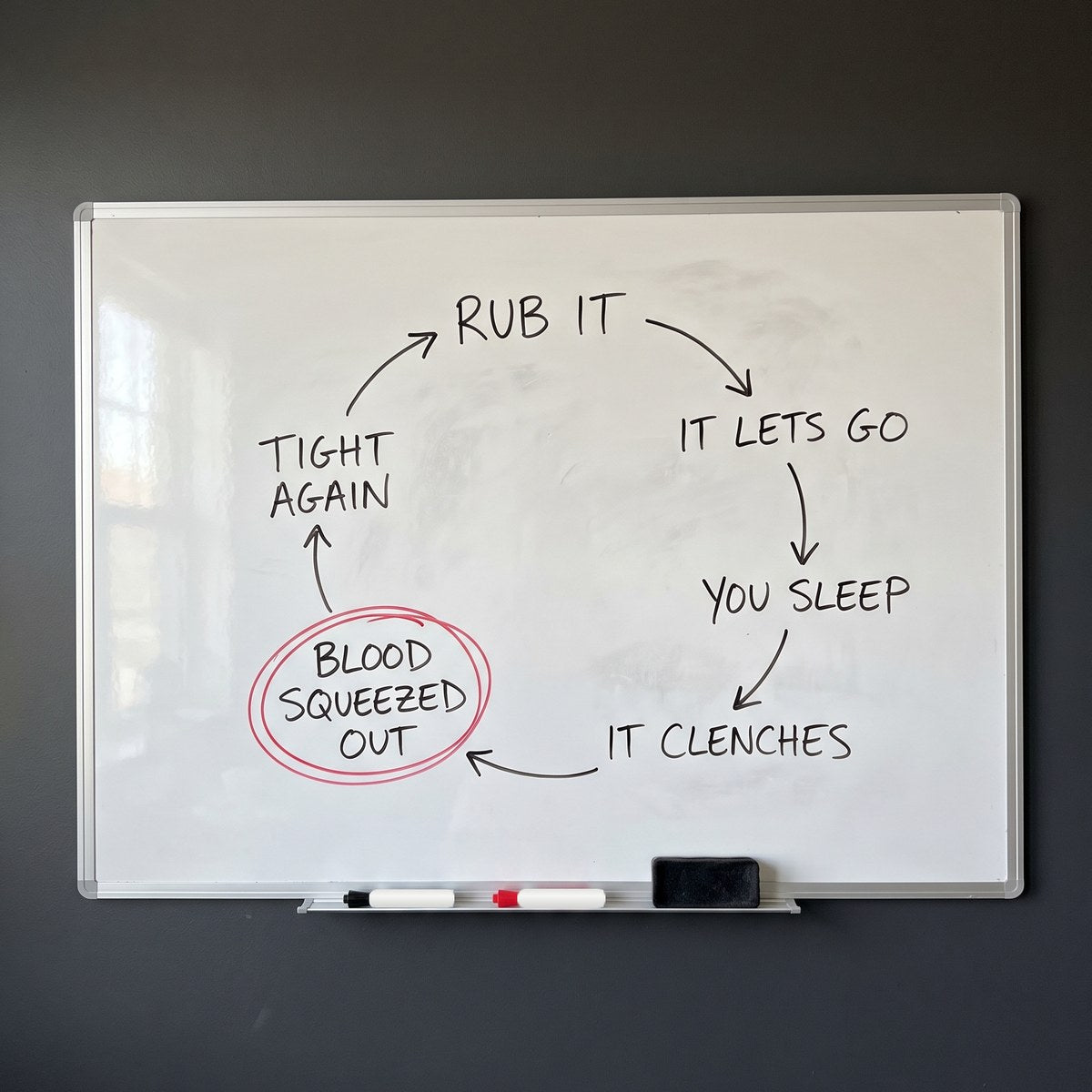
The muscle clenches and squeezes its own blood supply shut. With no blood, it runs out of energy. With no energy, it cannot let go. And because it cannot let go, it goes on squeezing its own blood supply shut.
That is the loop you are in. Rubbing opens it for a while. The night closes it again. It is why the relief is instant and why it never lasts.
Scans of the jaw muscle in people who grind found exactly this: less stored energy, even at rest.
And it is the one thing your thumbs cannot give. They can move blood for a minute. They cannot put energy back into a muscle that has run out.
What breaks the loopRed light gets energy into the muscle without needing the blood to carry it
To break the loop, the muscle needs energy. But energy normally arrives by blood, and blood is exactly what the clench has shut off. That is why rest, time and good advice all arrive too late.
Red light does not travel by blood. It travels through skin.
The jaw muscle sits just under your cheek, where your fingers were a minute ago. Red light at 660 nm passes through the skin and into the muscle.
Inside every muscle cell are the small parts that make its energy. They take the light in and make more energy from it. In muscle cells in the lab, light of this kind raised their energy to more than three times the untreated level six hours later.
With energy, the fibres can do the one thing they could not. They let go.
When the muscle lets go, it stops squeezing its vessels. Red light also widens those small vessels. Blood comes back in, and with it the oxygen the muscle needs to make its own energy again.
Now the loop runs the other way. Energy lets the muscle release. Release lets the blood in. Blood brings more energy.
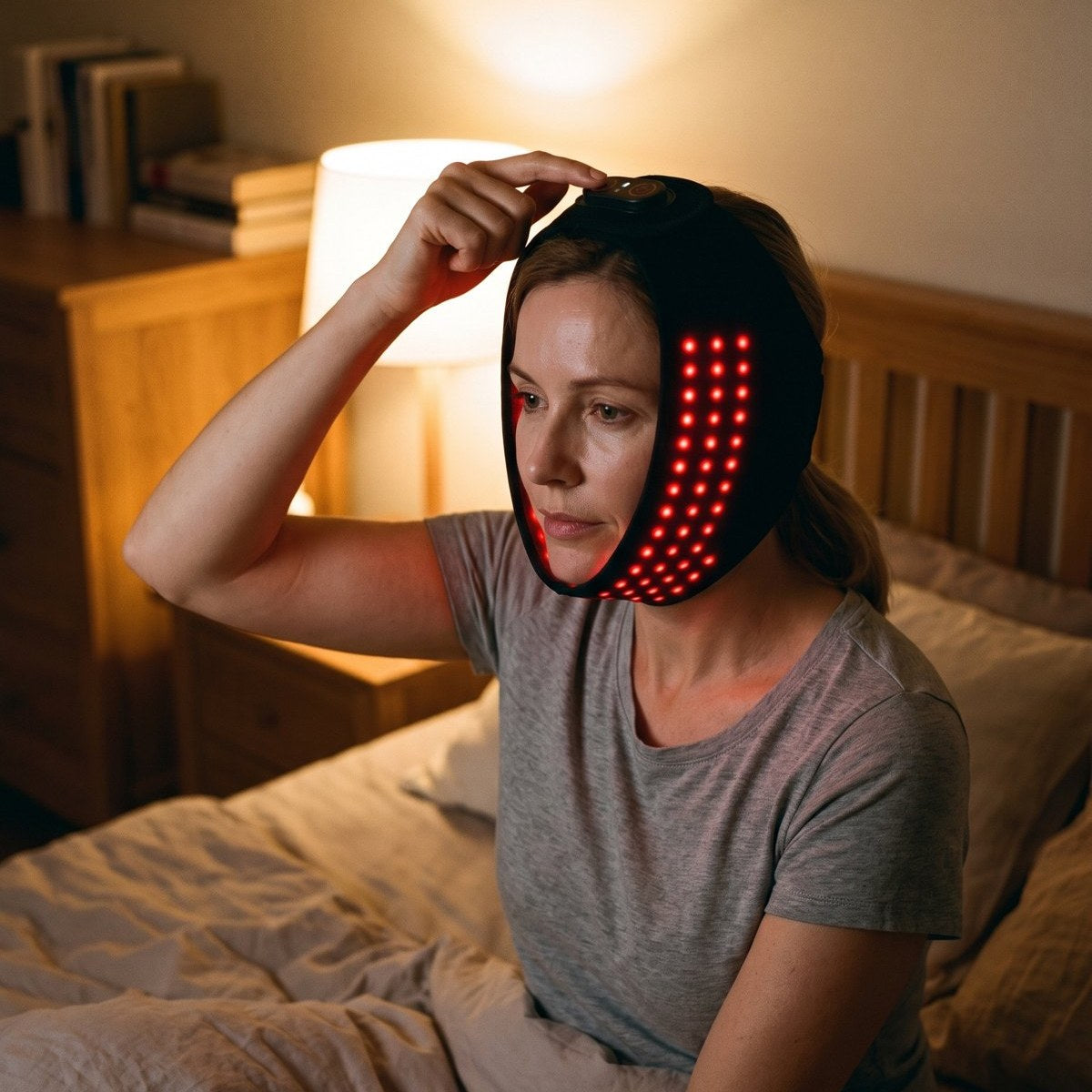
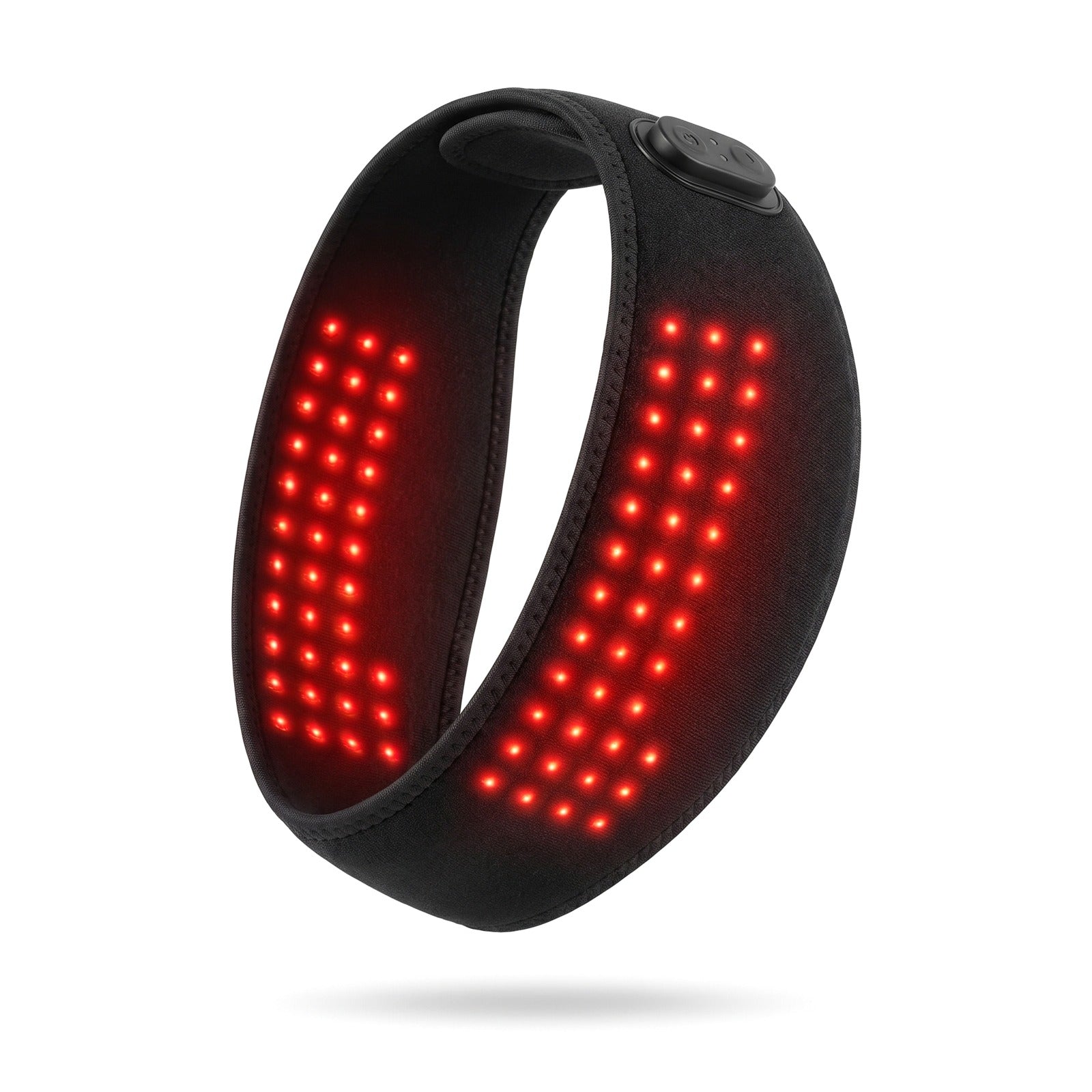
The jaw pad is how you put that light on the muscle at home. It is a soft black strap that wraps under your chin and up both cheeks and closes on top of your head. Rows of red lights at 660 nm rest on both cheeks and under the chin, over the muscle on both sides at once. It stays on by itself while you read or lie back in the evening, so the muscle goes into the night with energy in it.
It will not stop you clenching. Nothing stops a clench you cannot feel. It gives the muscle back what the clench takes.
The testSixty people with jaw pain, and a device that was switched off
You have been told things about your jaw before, so do not take this on trust. Here is what happened when red light was tested the hard way.
Researchers took sixty people with jaw muscle pain and split them into three groups by chance. One group had a red light at 660 nm held on the jaw muscles, five minutes a spot, once a week for three weeks. One group had a clinic laser. The third had the same red light device held the same way, switched off.
Neither the people nor the surgeon who scored their pain knew who was in which group.
A week after the last session, pain in the red light group had gone from 3.8 to 2.3 on a ten-point scale. In the switched-off group it had gone from 3.9 to 3.7. The red light did as well as the laser.
An earlier trial by the same team, with fifty people and a device with no battery in it, pointed the same way: both groups improved and the light group improved more, though that time the gap was too small to rule out chance.
In a third study the light went on the jaw muscle on one side and a dummy on the other. The lit side lasted longer before it tired.
These are small studies, and they ran for a few weeks. They are not the last word. But they are the opposite of being told to wait: someone measured it against a fake, and the light came out ahead.
Then there are the people who found it on their own. They are not our customers. They are people with jaw pain writing about red light they already owned.
“Get you a small red light therapy pad and lay on it for 30 mins every day. It’s what healed mine.”
“Can’t go anywhere without my red light now!”
“The days that I skip I feel the pain come back, use my mask, and feeling better. It only takes 10 mins, and I can just lay their vs doing the facial massages or stretches.”See how the jaw pad worksFive fair questions
"Should I not see a specialist first?"
If you can, do. This does not replace one. But the waiting list can run to months, and not everyone can pay.
“I cant afford any treatments or therapy at the moment. What do I do?”
That question deserves an answer. There is something between doing nothing and an appointment you cannot get or cannot pay for: red light on the muscle, at home, from the evening it arrives. You can do both.
"Red light sounds like a gimmick."
Fair. A lot gets sold to people with jaw pain.
So judge it on two things. The reason: it gets energy into a muscle whose blood supply is squeezed shut, and it gets there through the skin. And the test: it was put up against the same device switched off, with nobody knowing who had which, and it came out ahead. Most things sold for jaw pain were never tested against a dummy at all.
"How long before I feel anything?"
Longer than four days, as one person found out:
“I’ve tried the red light for about 4 days haven’t noticed a difference yet”
In the trials, people were measured over four weeks. So give it four weeks of evenings, and judge it by your jaw at dinner and when you wake up. You see the red light. You do not feel it.
"Will I actually use it?"
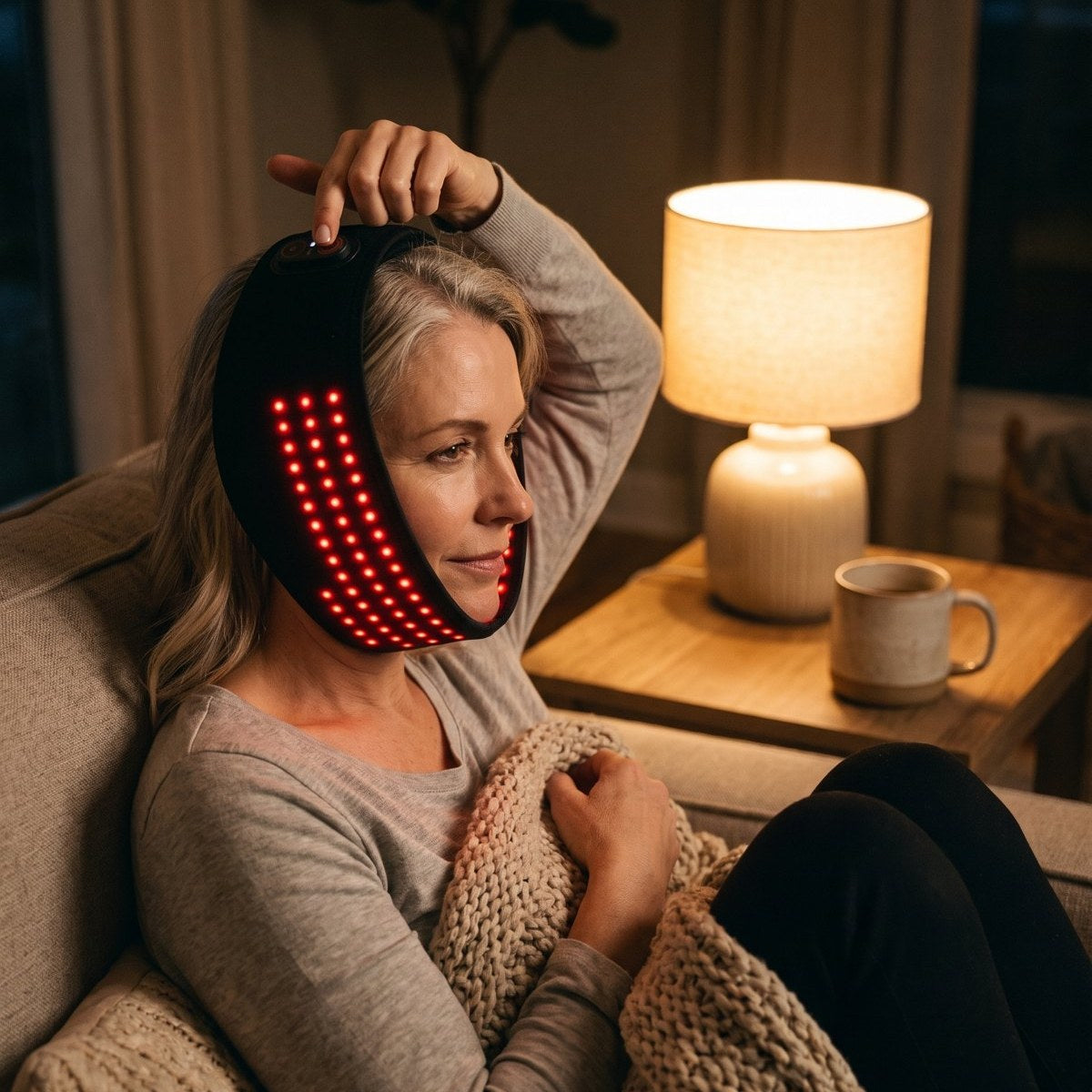
“If you have ever tried holding a red light panel against your jaw, neck, or knee, you know how quickly your arms get tired.”
That is why the jaw pad is a strap. It closes on top of your head and stays on by itself, on both sides at once. Nothing goes in your mouth and nothing needs holding. You put it on in the evening and read, watch something or lie back. There is a heat button if you like gentle warmth.
"What if I am one of the people it does not work for?"
That is the right question, and it is why you get 60 evenings. Wear it for 60 evenings. If your jaw is not better, send it back for a full refund. The trials ran for four weeks, so 60 evenings is enough time to know.
See how the jaw pad worksThe costWhat the other routes cost, and what this costs
People with jaw pain write down what the other routes cost them.
“I went to my dentist who sent me to a TMJ specialist, who I felt was sort of smug/not listening and quoted me 5k for splints before charging me $450 for the visit and ushering me out clutching a pamphlet on medical loans.”
A bill like that buys nothing that puts energy back into the muscle.
The jaw pad is $89, with free shipping and a free welcome kit. One strap, kept at home, used every evening.
See how the jaw pad worksYour choice60 evenings to find out what the muscle does when it is given energy, not just pressure

Wear it for 60 evenings. If your jaw is not better, send it back for a full refund.
Keep the massage if you like it. It feels good and it does no harm. But picture an evening where the work is done for you: the strap on, both hands on your book, the muscle on both sides getting what rubbing never gave it.
And picture the morning after, when you reach for your jaw out of habit and find there is nothing to rub out.
See how the jaw pad works
A soft strap that wraps under your chin and up both cheeks and holds 660 nm red light on the jaw muscle, both sides at once, hands-free, at home in the evening.
Red light goes through the cheek into the muscle the clench has starved, so it gets its energy back and can let go.
Wear it for 60 evenings. If your jaw is not better, send it back for a full refund.
See how the jaw pad works